

Choosing a cigar can be an overwhelming task when you are confronted with hundreds and maybe even thousands of choices. What color do you look for? What size do you want? Are there tell tale signs to watch out for when buying a cigar? All these questions will be answered.
Color
Without getting into too much detail, let’s look at the most obvious aspect of a cigar: color. The shade of the wrapper usually is an indication of the flavor of the cigar. The darker the cigar, the more likely it will be spicier. This is more of a rule of thumb than a hard fast rule. Most new cigar smokers will appreciate a lighter color. These are the general categories of color:
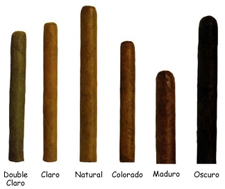
Double Claro - Known to have a greenish tint on its wrapper. It's a light cigar that has had limited aging.
Claro - Typically signifies that the cigar will be mild. It has a light brown color.
Natural - (also called English Market Select) light brown to brown. These are most often sun grown, meaning they are not protected by canopies like shade grown leaves. Fuller bodied flavor than shade grown leaves, but still very smooth.
Colorado Claro - This wrapper is your standard brown color. Slightly stronger than the Claro but still considered mild.
Maduro - These wrappers are dark brown and give off an excellent aroma. They are considered medium to strong cigars.
Oscuro - The Oscuro has a very dark brown, practically black wrapper and is strong in flavor.
The darker the color, the sweeter and stronger the flavor is likely to be, and the greater the oil and sugar content of the wrapper. Darker wrappers will normally have spent longer at the tobacco plant or come from higher altitudes: the extra exposure to sunlight produces both oil (as protection) and sugar (through photosynthesis). They will also have been fermented for longer.
Size & Shape
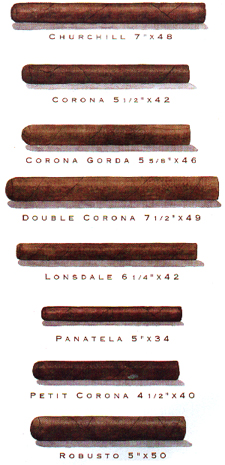
The names of cigar sizes rarely have anything to do with the actual size of the cigar. There aren't any universal standards to go by, so the best you can do is keep in mind that the size thing is just a guideline. And that is no more readily apparent than after you notice that one manufacturer's churchill is the the same size as another's double corona.
There are, however, "classic" measurements which will, when you become more familiar with them, allow to to make some general assumptions about a cigar's size. For instance, after you get to know the classic measurements, the next time you see the words "Double Corona" on the outside of a cigar box you'll know right away that what's inside is not a collection of short cigars.
But then you'll also want to keep in mind that just because the box says "Churchills" doesn't mean the cigars are going to be 7 inches long with a 48 ring gauge.
All you really need to remember is that cigars, in terms of their size, are generally listed by length in inches and the ring gauge, or the cigar's girth, which is in 64ths of an inch. So, a classic Churchill is 7 inches long and 48/64ths of an inch thick.
When choosing a size, it is important that you remember that the bigger the cigar, the longer it will take to smoke it. For new cigar smokers it is a good idea to stick with Coronas and Robustos.
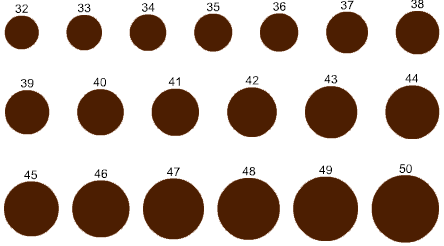
The size is measured by length and ring gauge (cigars diameter). One ring is equivalent to 1/64 of an inch. Some of the most common are:
- Panatela (6 1/2 x 35)
- Robusto (4 1/2 x 50)
- Churchill (7 1/4 x 48)
- Corona (5 3/4 x 42)
- Double Corona (6 1/2 x 48)
A cigar with a larger ring gauge will have a fuller and more complex flavor and produce more smoke compared to the smaller ring gauge cigars. The larger a ring gauge the more a cigar maker can blend and combine different types of leaves. Color also plays an important part in choosing your cigars. What you see when you look at a cigar is the wrapper and it plays a role in the flavor of your cigar. Usually the wrapper is described by the country of origin or color.
- Claro (light tan)
- Maduro (darkest brown)
- Oscuro (black)
- Colorado (reddish dark brown)
- Colorado Maduro (dark brown)
- Colorado Claro (mid brown)
Also when you look at the wrapper make sure it is not too dry or too firm or too soft. Before you buy check for cracks or defective wrapper although when you buy from TheCigarStore.com we do this for you.
The finest cigars in the world vary in size from about a 9X64 (which is one inch wide) down to approximately 4X30. The first number refers to the length of the cigar, in inches; the second is the ring gauge, or the thickness of the cigar, measured in sixty-fourths of an inch. Most cigar smokers gravitate to a particular size, so when considering the quality and consistency of taste and aroma of a cigar, your sense of comparability can be confused and it will be difficult to judge fairly unless you are smoking the size you are accustomed to. The same cigar blends in different sizes taste different, sometimes vastly different, because of the different ring sizes and lengths. A big ring gauge, 50 or 52, produces an immense volume of smoke compared with a 28, 36 or even a 42.
- Heavy Ring Gauge - All cigars with a ring gauge of 45 and up.
- Standard Ring Gauge - All cigars with a ring gauge of 40 to 44 inclusive.
- Slender Ring Gauge - All cigars with a ring gauge of 39 and under.
Warnings
There are 3 warnings for choosing a cigar:
- The cigar should not be too soft or squishy. When you give it a little squeeze, it should only “give” a little. If it is too soft then it is a sign of an over-humidified cigar.
- The cigar should not be too dry or fragile. This is a sign of an under-humidified cigar. Some people like them this way, but it is best to stay away from these until you want to experiment.
- Moldy cigars should be thrown away. Be sure you do not confuse mold with plume. Plume is the white ash like residue that can be brushed off. This is a sign of good aging.
Storing your Cigars **
Cigars are hygroscopic in nature. In lay terms, this means that they will over time dry out when in a dry climate or absorb moisture in a humid one. And they will continue to do so until their own moisture content matches that of the ambient climate around them.
A damp cigar will not burn properly. Not only will it be difficult to keep lit, but also difficult to draw on. The smoke may become too dense leaving the smoker with a sour taste and a rank aroma. Also, over moist cigars will commonly split their wrappers.
A dry cigar will burn too hot. Without the proper level of moisture, the combustion temperature of your cigar will be too high and the smoke will be hot and acrid against your palate. The smoke may become overly aggressive and you will lose many of the subtle nuances of flavor that a properly humidified cigar would of given you. Also, dry cigars will lead eventually to the early evaporation of their essential oils and reduce their overall flavor and aroma.
Typically for the most enjoyable smoking, a cigar should contain approximately 12 -14% of its total weight in moisture. This corresponds to 60 - 70% relative humidity, but can be up to 75%. Relative Humidity (RH) is a measurement of the amount of moisture in the atmosphere compared with that of complete saturation regardless of the temperature.
The primary criteria in the proper storage of cigars is to achieve a stable and ideal relative humidity within this 60% - 70% RH range. The secondary, but also important requirements are to store them at temperatures below 75 degrees Fahrenheit and in a darkened environment. Doing these three simple things will allow your cigars to not only be stored well, but also age well resulting in cigars that will draw easily, burn steadily, and share their optimum flavor and nuances with your palate.
Cutting, Lighting, Smoking and Ashing Cutting ***
Cigars are made with a cap over the head. Most good cigars, therefore, have only one open end. This is NOT the end that you put in your mouth - that open end is where the smoke comes out. So you need to cut the cigar at the head.
Cutters come in different styles, but the most common is the guillotine. The double-bladed guillotine has a hole in the middle, two blades, and two notches where your fingers can grip it. You should absolutely buy a guillotine as your cutter - they're easy, small, and they make a clean cut with less of a tendency to tear the tobacco than other styles. You can also use a knife or your teeth, but cutters are really cheap, and a knife may ruin the cigar.
Here's how to actually make the cut (it's really simple):
- Cut the cigar on the tapered part (the cap).
- Try to leave about 1/8th of an inch of the cap.
- Never cut on or past the cap line - you'll be cutting the wrapper leaf. All hell will ensue.
Lighting
This can be tricky for a newbie, but our tips will get you through it:
- It's best to light a cigar yourself - lighting a cigar takes longer than lighting a cigarette, and it's best not to feel rushed by having a friend reach over with a lit match.
- Matches or butane lighters are fine, but if you use a match, make sure the sulfur is burned out first so it doesn't impair the taste of the cigar.
- Never use a candle - the wax particles will enter the cigar and taint its flavor.
- Hold the cigar in your hand, not your mouth, and rotate it near the flame.
- Do not actually touch the flame with your cigar. When the entire surface is charred and embers appear, place the cigar between your lips.
- Gently puff to blow out any foreign particles or odors that may have come from the lighter or match. Check to see that the cigar is lit evenly. This probably goes without saying, but just in case you happen to have a pompadour with a lot of hairspray: remember to not set your hair on fire.
Smoking
Now that the cigar is lit, you should be able to draw smoke gently through it.
- Draw slowly by pulling in your cheeks. Do not suck or inhale.
- Do not smoke the cigar too forcefully or quickly - it will make it taste harsh and burnt. Just puff occasionally, making sure the cigar stays lit.
- After a few minutes, you may want to remove the cigar band (label). Some people think it is obnoxious to keep the band on while you smoke, and it's not really necessary to keep your fingers from getting stained. Make sure that you've smoked the cigar for a bit, though. If you remove the band too early, the glue will not have softened and you will risk tearing the wrapper.
Ashing
People smoking good cigars like to keep the ash on for as long as possible. Indeed, a solid tower of ash is a sign of a well-made cigar. But don't let the ashy end grow too long - this is both pretentious and an invitation for a mess on the floor. Every once in a while, just gently press the ash against an ashtray - the ash should fall off easily without you having to tap the cigar. If your cigar goes out, it's okay. This does not mean you are a bad smoker - just remove the ash and re-light it.
Smoke the cigar for as long as you want - the only time you should stop smoking is when it stops being enjoyable for you. When that becomes the case, just set the cigar down in an ashtray and it will go out on its own. Do not grind it out, as that will produce excess smoke. Just take one last draw, set it down, take a sip of your drink, and revel in your smoothness.